
|


|
|
Chiropractic Decompression Table
Welcome To Decompression Table.com Storefront!
This site is owned and operated by Access Equipment Corp.
Decompression Tables on this site are nonsurgical tables that effectively treats disabling low back, neck, radiating leg & arm pain, and headaches. Decompression Tables effectively relieves pain associated with disc herniation, degenerative discs, posterior facet syndromes, by reducing the pressure on spinal discs and facet joints through unloading created by distraction and positioning. Decompression Table Therapy effectively enhances the healing process and renders quick, effective and amazing pain relief that enables most patients to return to a more active lifestyle.
Looking for Decompression Table Marketing?
Check out our new WSP Deluxe Package Deal! We have just completed a BULK pre-purchase deal with WSP to bring you great package pricing.With this package you get everything you could need to effectively market your decompression table at a fraction of the price.The package must be purchased with a table from our site.If you have recently purchased a table and want to add it please call...
|
List Price: $9,545.00
Sale Price: $6,999.00
You Save: $2,546.00 (27 %)
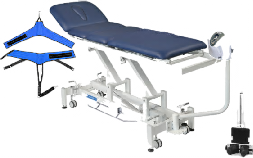
Four Piece Elevation table with Hand Control ,Tilt Head& Tilt Back Rest,Casters,Saunder Cervical Traction device,CarpalTrac,Split Knee Bolsters & Exclusive EZ-Grip Thoracic & Lumbar Belting System
|
List Price: $9,545.00
Sale Price: $7,599.00
You Save: $1,946.00 (20 %)
Four Piece Elevation table with Hand Control ,Tilt Head& Tilt Back Rest,Casters,Saunder Cervical Traction device,CarpalTrac,Split Knee Bolsters & Exclusive EZ-Grip Thoracic & Lumbar Belting System
|
List Price: $9,999.00
Sale Price: $7,999.00
You Save: $2,000.00 (20 %)
Four Piece Elevation table with Hand Control ,Tilt Head& Tilt Back Rest,Casters,Saunder Cervical Traction device,CarpalTrac,Split Knee Bolsters & Exclusive EZ-Grip Thoracic & Lumbar Belting System
|
List Price: $16,995.00
Sale Price: $10,995.00
You Save: $6,000.00 (35 %)
3-D Active Trac
|
List Price: $14,585.00
Sale Price: $11,999.00
You Save: $2,586.00 (18 %)
Four Piece Elevation table with Hand Control ,Tilt Head& Tilt Back Rest,Casters,Saunder Cervical Traction device,CarpalTrac,Split Knee Bolsters & Exclusive EZ-Grip Thoracic & Lumbar Belting System
|
List Price: $16,995.00
Sale Price: $13,995.00
You Save: $3,000.00 (18 %)
3-D Active Trac
|
List Price: $19,995.00
Sale Price: $17,900.00
You Save: $2,095.00 (10 %)
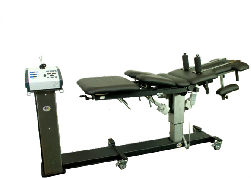
The table Combines Flexion Distraction Features & Decompession
|
List Price: $59,995.00
Sale Price: $24,999.00
You Save: $34,996.00 (58 %)
Used Lordex Decompression Table
| |
>
CONSIDERING DECOMPRESSION THERAPY?

Each patient and situation have differences that could necessitate a different course of action, and that is important to remember when chiropractors use spinal decompression therapy, says Matthew McCoy, DC.
McCoy, editor of the Journal of Vertebral Subluxation Research, notes that if your patients start feeling better, their muscle strength starts improving, their reflexes get better, and the sensory deficits start to improve, “They are responding to your care, and you are in control of the case.”
If they start “going south,” don’t improve, or don’t improve as rapidly as they should, you need to make a referral, says McCoy. That does not mean that you have to stop treating the patient — it means you need to get another provider’s opinion.
Bearing all that in mind, below are some guidelines for appropriate management of spinal decompression cases.
• Proper diagnosis. Experts agree that spinal decompression works for patients diagnosed with compressed or herniated discs. Because there are different stages to the natural history of disc problems, spinal decompression can be appropriate for patients who have bulging discs, all the way to patients with herniated discs.
Contraindications for this therapy include spinal stenosis, spinal fusion, spinal tumor, or motor problems that are progressing despite treatment.
• Length of treatment. Disc syndromes can be stubborn in terms of response to treatment. Rather than a “cookbook” approach, McCoy advises that length of treatment be determined based on each patient’s particular circumstance. He believes it is reasonable to expect that after 12 treatments there should be evidence of some demonstrable benefit.
The most important thing is to re-evaluate patients’ progress on a regular basis, including neurological signs such as muscle weakness, a decreased reflex, and sensory disturbances. If patients are not improving, alter their care plans.
• Ongoing monitoring. The frequency and extent of re-evaluation during treatments depends on the specifics of the case and might include brief neurological checks on each visit in order to monitor motor, sensory, and reflex functions. If the patient experiences an exacerbation in the middle of the care plan, a more extensive re-exam might be warranted.
As long as the patient is demonstrating progressive and ongoing improvement, the treatment could continue. Measure the improvement in terms of pain as well as function: mobility, activities of daily living, and especially motor function.
• Warning signs. Several indicators warrant a change in treatment or referral to a specialist according to McCoy.
These indicators include: decreased reflexes, muscle weakness, increased sensory disturbances; difficulty walking; foot drop; problems with urination and/or defecation; increasing difficulty with sleeping; increasing and especially constant pain; pain that is not relieved by any intervention or position; or bilateral leg and lower extremity symptoms — especially if progressive.
• Referrals. Assess, on an individual basis, whether to refer a patient to a specialist; however, McCoy warns the most significant issues have to do with progressive deterioration of the patient’s condition. A significant increase in pain alone might warrant referral, but typically it is deterioration in neurological function that will necessitate it.
• Comprehensive treatment. McCoy notes that rehabilitation is generally an important part of all spinal care but especially with disc syndromes. Patients with mechanical spinal disorders will often be de-conditioned. It makes sense to incorporate core conditioning and overall strengthening as part of a complete treatment plan.
|
|
|
|